Tiiu Vaikla Põldma
The Dynamics of theory and Practice in Design Learning: Contexts, Service and a Discipline in Evolution
INTERIOR designers and interior architects are pragmatic. Whether it is solving problems of space and use or designing interiors of different kinds, they do so considering people’s lived experiences within physical and virtual spaces, both at the heart of the designs and usually what drives aesthetic concerns of form and space. however, increasingly, interior design is becoming a discipline where everyday pragmatic, human issues are confronted with social, ethical and situational needs in an ever-changing complex world. Over the past 20 years, time and space has been collapsing as the world moves into a new paradigm. We communicate 24-7, we transform interiors for new uses daily while we live increasingly in urban interior environments over 90% of our days1 and world demographics are changing rapidly as we enter older age around the world in increasing numbers.
Subsequently the ways we live are transforming ethically, politically, aesthetically and globally as current humanitarian crises, changing demographics and changing technologies are transforming society. gone are the days of designing purely for aesthetic desire, and increasingly both function and aesthetic needs feed new ways of seeing and understanding lived spatial environments. Space itself is becoming increasingly governed by those spatial experiences that support the lived experiences of people who live, play and/or work in multiple, flexible interior spaces daily, and each in very diverse lived situations and depending on their particular lived experiences.
In terms of designing in today’s world, professional interior designers require a broader skill set that encompasses reflective elements of design inquiry ‘thinking’ while embracing continually changing technological and aesthetic elements and turning concept development into ‘doing’. how do we combine traditional ways of understanding design with new social and ethical issues driving design solutions? How do design choices impact on social and ethical design considerations?
Through the lens of design futuring, I will propose that student learning can best be supported by project-based activities that promote reflective practices integrated with research practices, and are grounded in contextual project-based learning. Using examples of final design projects in a baccalaureate interior design programme at the Université de Montréal, I will propose what this means, how design professional teachers help to bring real-life situational contexts to student thinking, and how students can engage in theory with practice in the design studio. Three student design final projects reveal how they consider complex and dynamic problems, how practice is engaged, how change transforms ways of thinking about designing interiors, and what this means in terms of how students can acquire the tools to be responsive by designing for the real world experiences that people have.
1 Tiiu Poldma & Magdalena Wesolkowska. ‘Globalization and Changing Conceptions of Time-Space: A Paradigm Shift for Interior Design?’ In-Form 5 (2005): 54-61. EPA, Environmental Protection Agency (Washington,
USA, 2009), 11-12.
The Issues - Interior Design Practice, Design Futuring and Education Practices
Disciplines evolve through both how knowledge is produced and how it is documented. This happens with different forms of research that can be applied into practice. Now more than ever before, interior design as a discipline is shifting towards a dynamic of practice engaged with issues in the world. In terms of professional evolution, interior design in North America is emerging as a discipline grounded in the art and science of creating innovative and aesthetic interiors that are created with broad and specific skills to ‘…enhance the health, safety, welfare and performance of building occupants.’2
Building theory for interior design means understanding the dynamic issues that confront interior designers in practice and translating these into tools that students will need for futuring design concepts when situating project issues in life situations. In essence, this means understanding the vital role of reflection and action in design thinking processes, and how these concepts are the building blocks for the service-oriented goals of designing interior spaces that account for people of all ages and stages in their community and as full participants in society.
Design futuring has become a means of proposing how design education can capture emerging practices in a fast – moving and changing global world. Massive changes in how design is being done worldwide drives the necessity of training design professionals that can empathise and problem-solve in difficult and sometimes dire situations where there are global crises. And yet many design programs still privilege design education as a foundational learning of design elements and theories in a more or less abstract manner. This happens in many schools as designers are taught to be independent thinkers driven by intention and prime aesthetic concerns who use the prime tools of design intention and individual-driven program development.
The architect Michel Dubuc speaks of the influence of business in design thinking and the need for ‘design futuring’. he notes that an alternative view is one where design goes beyond the ‘…designers him or herself or defined and limited by a functional brief…design takes on meaning by becoming multidimensional, connected, interactive, collaborative and even democratic’.3 Whether it is new coded cultural forms, ethical practices, sustainable approaches, technological aesthetics or critical pragmatism, these are all approaches that position theoretical concepts in the realm of spatial environments and their designs that broaden the traditional intention-driven approach. Elaborating further, tony fry suggests that design futuring must integrate sustainable approaches and an engagement with ‘action as praxis’.4 As Fry explains
‘…action created beyond what is instrumentally directed. …action can be understood as that which forms humanity as collective, as community, as society, as polis, as particular identities and as difference. Action, as praxis, is futural in so far as it secures being.’5
2 CIDA, Professional Standards 2014 Council for Interior Design Accreditation, 2014. https://goo.gl/qzZJwD
3 Michel Dubuc, ‘Design futuring’, Meanings of Designed Spaces, ed. t. Vaikla Poldma (New York: fairchild Publications, 2013), 451-452.
4 Tony Fry, Design Futuring: Sustainability, Ethics and
New Practice (Sydney: University of New South Wales Press,
2009), 27.
5 Ibid.
Change, Collective Action and Context
In the interior design profession, we consider sustainable approaches to be vital and user needs to be quintessential, and we say we ‘research’ when we gather what we need for a given project, and put the research into decision-making action in changing environments for new and potentially unforeseen uses. however, within the profession, there are few debates about broader social and cultural issues, how vulnerable populations are forced into living in squalor and how current global issues driven by technology affect society rather than supporting all people within their lived environments in the universal sense. In fact, the ethical and philo sophical underpinnings that we require for our profession to mature, issues that inform and concern interior design/architecture specifically and the built environment and design more generally, are not often understood nor debated within the field.
In their seminal book The Design Way, Harold Nelson and Erik Stolterman6 speak of ‘transformative change’ as an agent of design. In our work as designers, interior designers transform spaces and provide possibilities when we design interiors.
Purposeful and innovative designed spaces require the coming together of designer with user in real-life understanding of the experience to which the spaces will respond, through the vehicle of conversation as aesthetic meaningmaking. 7 Designers cannot design without understanding and empathising with how the proposed spaces will respond to people’s lived experiences.8 Understanding and responding to the real, lived experiences of users means understanding how people actually live, and may include using a phenomenological approach to understanding dynamic experiences in spaces.9 This requires interpreting issues and concepts in a reflective and reflexive manner. fry suggests that ‘…design remade into view within and beyond the design community initially requires the development of new knowledge, interpretive skills, objects of experimental encounter and objects of critical reflection.’10
As architect/designer Michel Dubuc suggests, design thinking thus takes on perspectives of engagement in multidimensional ways. This means engaging theory with practice. In terms of the dynamics of theory and practice, spaces can be understood with these concepts in mind. Researchers can become global and practice-aware, while practitioners can understand the value of research as a means of informing design practices. Collaborative design, ethical design and critical pragmatism are all theoretical ways we can understand our world and ways researchers can contribute to design problems. This added dimension allows students to experience the complexity of problem situations, and learn how to empathise with users and their experiences as they make meaning of what has value11 and how this can be reflected in the designs created.
Teaching interior design therefore becomes a collective engagement of world-situated design issues and problems. This includes integrating the situations that interior designers face within the design aesthetics of building interiors and the dynamics of 24-7 living and working environments for humans, people who need to do things, go places and do so regardless of age, sex, race, gender, or culture. Designing means reflecting on and informing practice, responding to what people want, what they need and to do so with a sensitivity to their lived state, whatever that may be. for interior spaces and their creation, in essence this implies a sustainable view – meaning designing for everyone, and, universally speaking, including the community.12 Collective action includes designing for the experiences and needs of everyone.
6 Garold G. Nelson & Erik Stolterman, The Design Way: Intentional Change in an Unpredictable World (Englewood Cliffs, NJ: technology Publications, 2012).
7 Tiiu Vaikla Poldma, ‘An Investigation of Learning and Teaching Processes in an Interior Design Class: An Interpretive and Contextual Inquiry’ (unpublished doctoral thesis, Montreal: Mcgill University, 2003). Tiiu Vaikla Poldma, ed. Meanings of Designed Spaces (New York: fairchild Publications, 2013).
8Ibid.
9 Tiiu Vaikla Poldma, ‘An Investigation of Learning and Teaching Processes in an Interior Design Class: An Interpretive and Contextual Inquiry’ (unpublished doctoral thesis, Montreal: Mcgill University, 2003). Tiiu Poldma & Magdalena Wesolkowska, ‘Globalization and Changing Conceptions of time-Space: A Paradigm Shift for Interior Design?’ In-Form 5 (2005): 54-61.
10 Tony Fry, Design Futuring: Sustainability, Ethics and New Practice (Sydney: University of New South Wales Press, 2009), 27.
11 Mihaly Csikszentmihalyi & Eugene Rochberg-halton, The meaning of things: Domestic Symbols and the Self (UK: Cambridge University Press, 1981).
12 William Lidwell, Kritina holden & Jill Butler, Universal Principles of Design (Gloucester, Massachusetts: Rockwell Publishers, 2003).
About Critical And Ethical Design Approaches: Considering Social Constructions
When learning about how to design in a design studio, students are confronted with design situations and design problems of varying degrees, but these often are theoretical and somewhat artificial. Students may not grasp the implications of their design intentions and decision-making in the concepts that they develop. They need to understand and empathise with peoples’ experiences as lived and real, and as these exist in the real-life settings of the users that they design for.
Most design problems in interiors suggest a ‘user’ or a ‘client’, and the foundations of interior design lie at the intersection of function, purpose, intention and service – aimed at the space and its occupants.13 By its nature, human activity also has combined social and personal activities particularly. When it comes to interior spaces, whether it is interior architecture, interior design or spatial design, human experience intersects with space, meanings and intentions. Confrontations with the social construction of reality are necessary to situate this learning in the context of understanding how things actually work in real world settings.14 In other words, what we design has broad ethical and social implications beyond merely choices made in physical materials or spatial configurations, and for students these skills are necessary alongside the more technical ones.
Design thinking is applied as a systematic process to understand the project parameters, and how users become engaged. how? Through engaging in scenario-building in the design studio through on-the-ground research on problems requiring innovative solutions. Adding research into design problem situating using context-based scenarios provides students with complex situations to investigate and explore, through the lens of project–based situations and by understanding problems in diverse contexts. Situating the design problem within the research and in project-based learning is a way for students to confront issues, understand contexts, and through empathy develop their reflective practices, skills that can then be transferred into the world of practice.
13 Joy Monice Malnar & Frank Vodvarka, Interior Dimensions: A Theoretical Approach to Enclose Space (John Wiley & Sons Inc, 1991). Tiiu Vaikla Poldma, ‘An Investigation of Learning and Teaching Processes in an Interior Design Class: An Interpretive and Contextual Inquiry’ (unpublished doctoral thesis, Montreal: Mcgill University, 2003). Tiiu Vaikla Poldma, ed. Meanings of Designed Spaces, (New York: fairchild Publications, 2013).
14 Peter L. Berger & Thomas Luckmann, The Social Construction of Reality (New York: Anchor Books, 1966). Tiiu Vaikla Poldma, ‘An Investigation of Learning and Teaching Processes in an Interior Design Class: An Interpretive and Contextual Inquiry’ (unpublished doctoral thesis, Montreal: Mcgill University, 2003).
Teaching Interior Design - Developing Discipline Specific Stances
One problem of interior design is its insistence on professional generalisation at the expense of disciplinary theoretical development. While we are generalists and favour this, we also are insecure about our profession and look to other professional expertise for theoretical concepts. Examples are visual arts, architecture and psychology, to name a few disciplines, where theory is developed, situated in the subject of the built environment, and then applied into interior design practices.
As we teach our interior design students the specificities of the discipline, we instil design thinking skills, technological know-how, and design elements and processes, alongside the many inter-disciplinary aspects of designing that we need to inform our interior design knowledge. We balance built environment knowledge with knowledge about people as users of spaces, spatial design with virtual expression of spatial environments, and both objects and people within what is an ephemeral concept: interior spaces. And essentially, students learn valuable insights about designing interior space when they have exposure to professional experiences. In the design studio final projects, the teachers are professionals who become temporary users and clients, and whose goals are to bring ideas of pragmatic project-based situating in problem-solving, challenging students to develop reflective and investigative skills as independent thinkers.
Project-based Learning as a Vehicle for Change-making and Action
Reflecting on practices and evolving design thinking are intrinsically linked to pragmatic problem-situating in project–based design situations grounded in the real world as this is done in interior design practice. One way to instil community-based ideas and collective reflection as tools for design action is to encourage projects that provide context-situated elements as part of the design situation as a way to encourage design futuring that is both innovative and pragmatic. Process and problemsolving then are anchored in project-based learning, where learning occurs by juxtaposing lived experience-based issues with learned theories and both ‘thinking’ and ‘doing’ so that these occur together.
This requires that students be confronted with how the theory-informed concepts learned in the classroom can be understood, even applied, in practical situations, and what happens when design problems are explored in context and in consideration of evidence-based information.15 In the design studio presented, Michael, Elaine and tiiu bring with them over 80 years combined current professional expertise that supports these approaches.
15 Rosemary Botti-Salitsky, Programming and Research: Skills and Techniques for Interior Designers (fairchild Books, 2009). Linda L. Nussbaumer, Evidence-based Design for Interior Designers (New York: fairchild Books, 2009). Tiiu Poldma & Michael Joannidis, Exploring Real-life Settings: Integrating Research and Learning as Thinking-and-Doing in Design Studio Projects, DRS-Cumulus 2013 2nd International Conference for Design Education Researchers ‘Design Learning for tomorrow: Design Learning from Kindergarten to PhD’, Oslo, Norway 14–17 May 2013.
Expanding the Nature of the Interior Design Problem: Integrating the Design Brief, the program and the Contexts
In this type of learning situation, students are confronted with the dynamic of human experiences in interiors with three specific elements. first, the systematic approach of understanding the user, the client, the design programme and the project goals is understood and learned through exercises prior to arriving in the design studio. Second, in the theory course students are asked to develop programs by confronting both theoretical and practical notions about the design process as it is practiced. They develop design programmes and when they arrive in the final studio, transform the programmes into functioning design briefs.
They make decisions and take responsibility for their projects as they transform the design programme into a working design brief. The nuance here is the application of context of the real world within the scenario building that students do when making decisions about the project, the client/user, the project situation and the specific parameters of the project. The ‘design programme’ is no longer a theoretical exercise; it becomes situated in theory and practice working together. The building of theory into practice and back again serves to hone skills previously learned in more theoretical settings in previous years, and transfers these theoretical skills towards the realities of real-world problems that await students as future designers. Finally, students appropriate their project in terms of theme, subject and content, guided throughout the process by the professor as facilitator. Decisions are made both individually and in the group in terms of discussions, with feedback from students and professors alike, as collaborative concept and theory building in the context of design practices. Through the narratives I explore these theoretical themes in the context of three design studio projects next.
Questioning the Framework of Conventional Interior Design Projects: Three Design Projects in Final Studio 2014
Valérie | Emergency Medical Intervention Unit For Crisis Situations
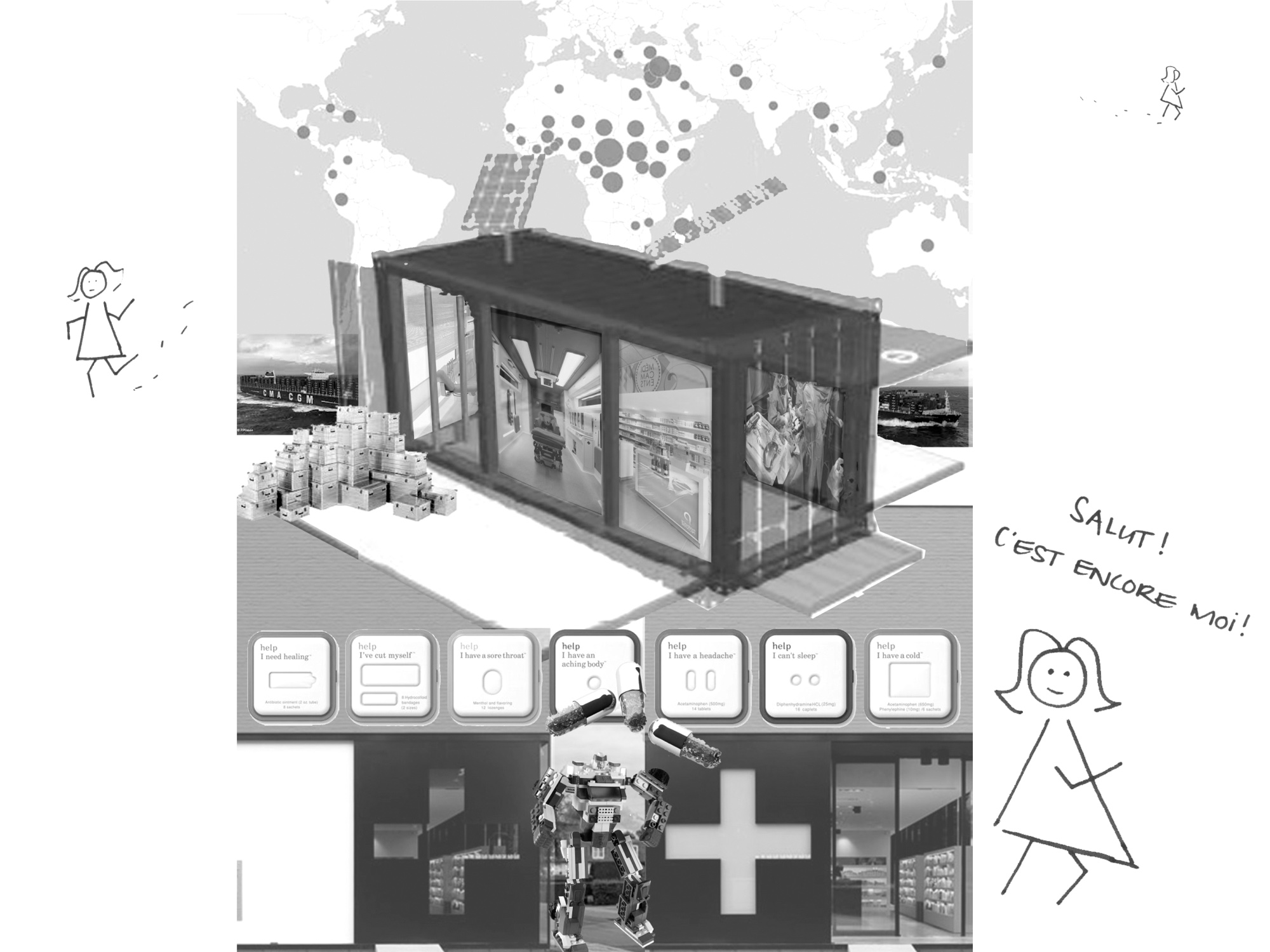
In this first example, Elaine describes the activities of Valérie, who used visual mapping to develop projects that questioned the framework of conventional projects in healthcare and specifically by designing emergency intervention units for disaster areas.
Elaine: A cross between logistics, interior design, architecture, and industrial design, a large portion of the project required detailed technical research and analysis in order to determine the intricate parameters of a highly complex design for multi-use modular health care units to be deployed at a moment’s notice to crisis areas. The initial program consisted of one module (a container) with four possible different functions: medical clinic, dispensary, sterile surgery, and logistic unit, all of which use the same components but have different interior configurations. As the project evolved, the student realised that the stringent requirements associated with a sterile surgical unit required a larger space than that allowed by the container, so based on case studies, she designed an expandable unit. Based on her desire to create a truly viable design, Valérie continued to imagine the parameters of the ‘how’. The end result went far beyond what many attribute to the field of interior design. Simply put, it is design.
(image courtesy Valérie Jacob)
Exploring Public Spaces in Unique Ways: Michelle and Sonia Push the Boundaries
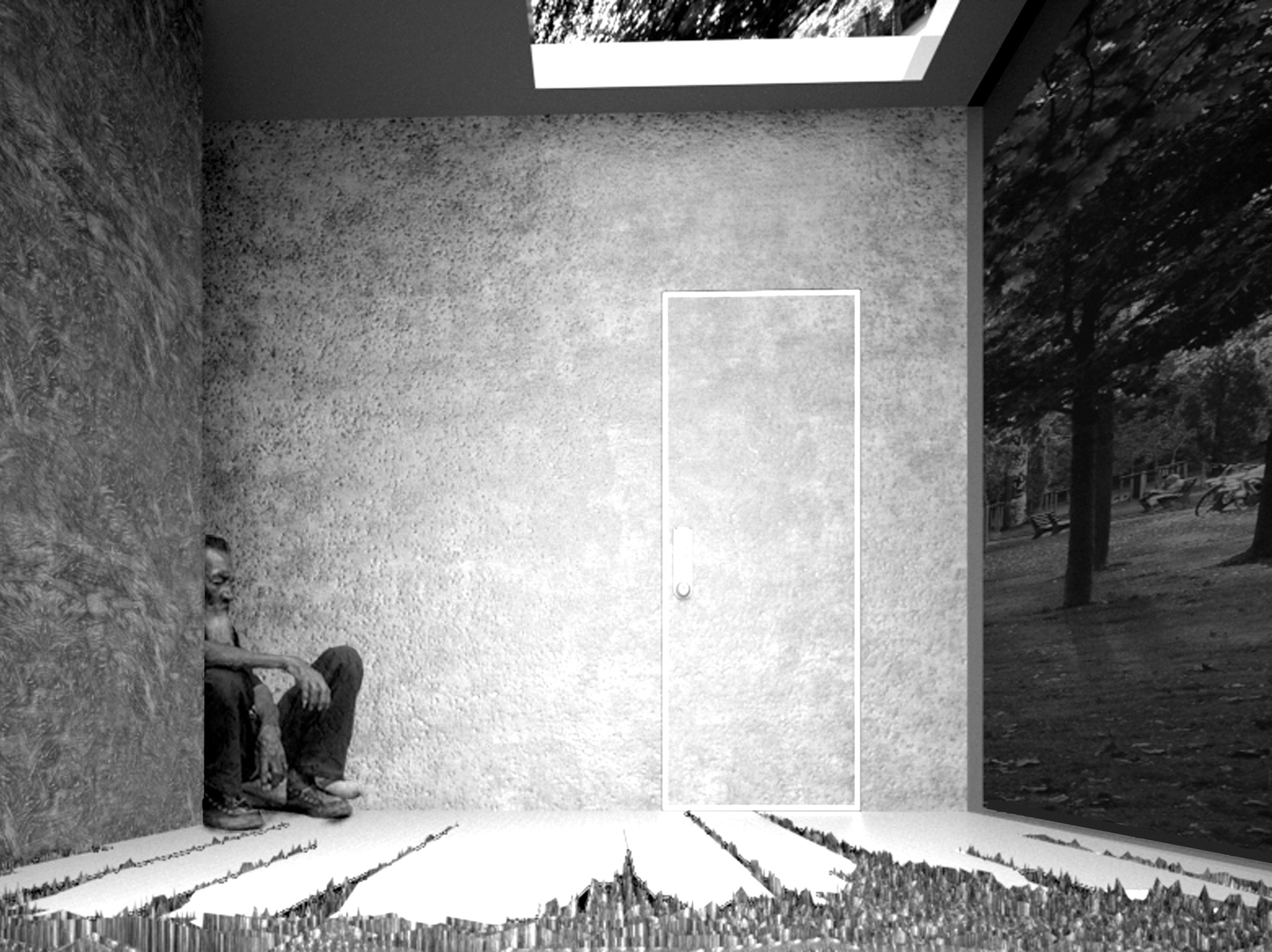
In this second example, Michael’s students push the boundaries of design thinking, exploring issues with contexts of driving societal needs for interiors in new ways, as in Michelle’s design proposal of the residence for a homeless person.
Michelle | A Private Residence for the Homeless Person
Michael: While most projects of this kind are almost predictable, laboured and remain somewhat superficial (in both treatment and resolve), this project is an excellent balance (and blend) between current social preoccupations and its very reason for being. It is a mature exploration into a very plausible premise whereby I had proposed to the student a hypothetical (simply to augment the design challenge) by asking her; what if the government along with a private developer were to launch a ‘lottery’ for the homeless? Through which one ‘lucky’ winner who is destitute and living on the street could actually have the opportunity ‘for a second chance at life’ and actually win his/her very own ‘home’…what would it look like and how would its interior be designed?
Changing the Role of the Institution
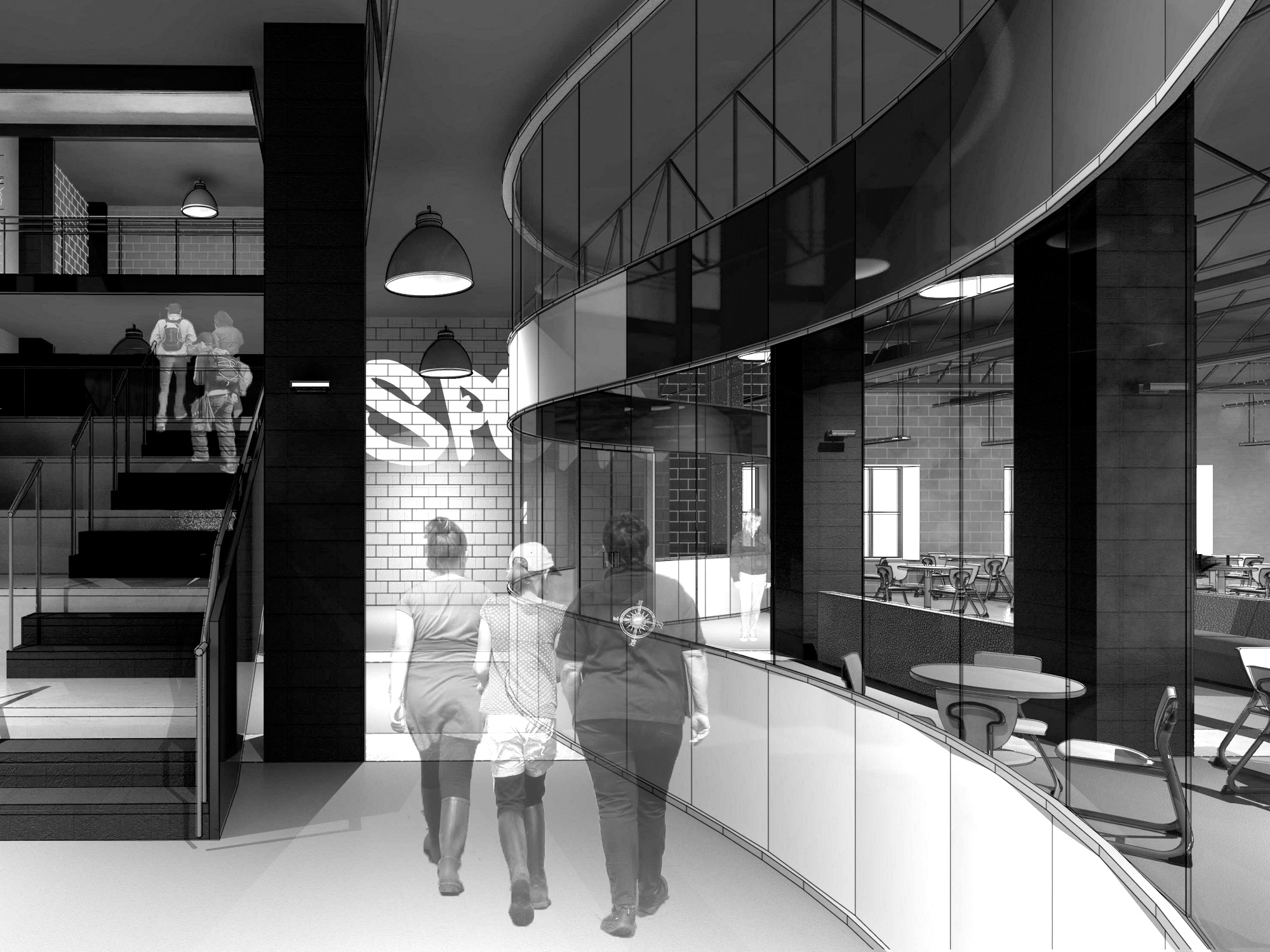
Tiiu discusses how Genevieve confronts institutional spaces for teenagers and young adults at risk, and explores realities with both clients and users in the design of a high school.
Genevieve | Secondary School for Students at Risk
Tiiu: The unique aspect of the project was the need for the interior public spaces being created to reflect the Student governance Body, a democratic decision-making body that students and the administration had in place to govern student activities and deal with the administ ration of the school, with the administrative consent. The complexity of student governance, bringing in kids from the street and offering them a place to learn under conditions where they had a say, were fundamental aspects to the design brief and subsequent visual development of the functional design. The resultant spaces were flexible, multi-purpose and in support of the activities of the democratic student/administrative body governance, with an added aesthetic of ‘bringing the streets in’ and giving the students spaces to express themselves from their perspective.
(Courtesy: Genevieve Hart)
Discussion
When creating spaces for seemingly unconventional approaches for interior design projects, the response runs the gamut of possibilities. The tutor raises issues that the student has yet to consider, pushing them to look beyond their initial thoughts. The depth of the inquiry often surprises students, not having realised that their initial idea was so complex. Valérie’s design thinking was based on research and case studies, and considering the basic needs and the imaginable solutions allowed Valérie to develop in-depth approaches to her concept, as suggested by Elaine. Michelle’s project is provocative and intellectual in approach, and, as noted by Michael, exceeds the usual mere aesthetic preoccupations and industry trend obsessions by proposing to delve into more complex issues + factors that are otherwise not often rendered available to an interior designer – since they are normally associated with other disciplines such as architecture and/or industrial design.
Finally, Genevieve brought together seemingly diverse political and social issues with the goal of designing social spaces for kids at risk within a framework of an institutional environment, and doing so with an aesthetic that responded to the student’s needs and understood administrative and political issues.
Conclusion
As we have seen, student learning is engaged and innovative when students are confronted with complex situations where they can devise design concepts in response to those. Real-life project-situated issues and the research done adds richness to the design studio learning experience. Critiques constructively added to student understanding of the relative success of proposed design solutions.
Design futuring thus becomes ingrained in student approaches to interior design situated problems. By examining problems from multiple perspectives and engaging in theoretical ideas through practice-based scenarios, students situate the designing for themselves and envision futures for people who can benefit from their design thinking. Integrating both theory and practice to generate innovative and new ideas as possibilities for both improving the space and its use and helping to rethink the value of diverse users and how they can help add value to designed environments creates better lived experiences for people in a complex and everchanging world.
The author acknowledges the contributions to this paper by Michael Joannidis and Elaine Fenton, professional designers and professors in the Final Design Studio held in the winter of 2014 in the Interior Design Baccalaureate at the Universite de Montreal, in Montreal, Canada. Michael Joannidis is also the professor of the course Conceptual Foundations (Fondements Conceptuels), as the foundational course for the final design project development that forms the basis for the student design solutions presented.
Parts of this paper were previously presented by Michael Joannidis and tiiu Poldma at DRS Oslo, May 2013. (DRS-Cumulus 2013 2nd International Conference Design Learning for Tomorrow: Design Learning from Kindergarten to PhD)